
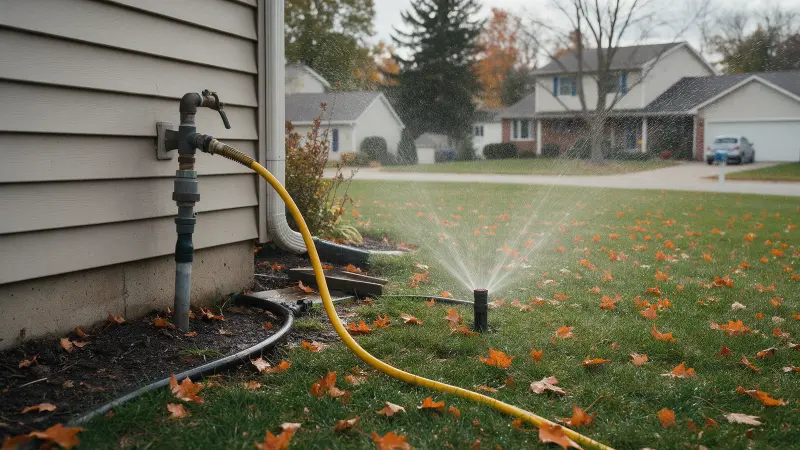
The Short Answer
Winterize before sustained hard freezes, typically October or early November in northern Illinois. Shut off the irrigation supply, drain the backflow preventer, then use compressed air to push the water out of each zone in turn, one zone at a time, at controlled pressure. Leave the backflow device's valves half-open so any remaining water has room to expand.
Water left in shallow lines, heads, valves and the above-ground backflow device expands when it freezes and splits fittings and bodies. That damage shows up at spring start-up as cracked lines, broken heads and leaking backflow preventers, the most common spring calls for Romeoville irrigation leak repair.
When to Winterize
The goal is to finish before the ground and above-ground parts see a multi-day hard freeze. A single light frost is rarely a problem for buried pipe, but the backflow preventer sits above ground and is exposed to air temperature. Scheduling earlier in the season avoids the rush, when irrigation companies' fall calendars fill up.
If a leak turned up late in the season, repair it before winterizing. A broken pipe lets air escape during the blowout, so the zone won't clear properly.
How a Blowout Works
- Shut off the irrigation supply at the shutoff valve, usually inside the house where the sprinkler line branches off.
- Drain the supply pipe between the shutoff and the backflow preventer, where a drain or waste valve is provided.
- Connect the compressor at the blowout port after the backflow preventer. Air should never be pushed through the backflow device itself.
- Run one zone at a time at regulated pressure until only mist comes from the heads, then move to the next zone. Don't run air through a zone that's already dry, because friction heats the fittings.
- Leave the backflow device open to drain. The test cocks and ball valves are typically left at a 45-degree, half-open position.
- Set the controller to off or rain mode so it doesn't cycle the empty valves all winter.
Pressure should be kept moderate and within the limits of your pipe and components. Poly pipe and older systems generally call for lower pressure than newer PVC. Getting that wrong is one reason many homeowners leave blowouts to a provider.
Safety Notes
- Compressed air can launch debris, caps and nozzles. Wear eye protection and never stand over a head.
- Open a zone before the air is turned on, so pressure never builds against a closed system.
- Don't use a small pancake compressor for a whole system. It can't move enough air to clear the lines.
- Drip zones need lower pressure. Filters and regulators may need to be drained or brought inside. See drip irrigation repair.
Protecting the Backflow Preventer
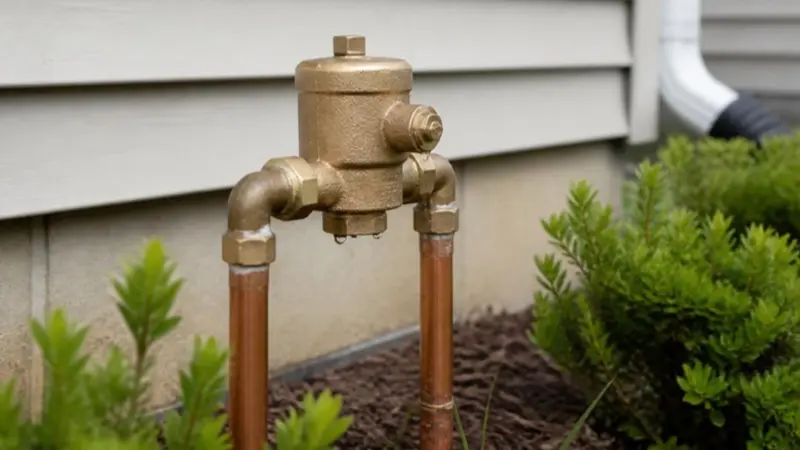
The backflow device is the part most likely to crack. Drain it fully and leave its valves half-open. An insulated cover adds some protection, but it doesn't replace draining. If yours cracked last winter, it will usually need a rebuild or replacement and a test by a licensed tester. See our guide to backflow testing in Illinois.
When spring comes, follow the spring start-up checklist to bring the system back online without damage.