
The Short Answer
Illinois requires lawn sprinkler systems connected to drinking water to have backflow protection, and testable backflow devices must be tested at least once a year by a Cross-Connection Control Device Inspector (CCCDI) licensed by the Illinois Department of Public Health. A device that fails must be repaired or replaced and retested.
Testing confirms the device will actually stop sprinkler water from flowing back into your home's drinking water. It's separate from, and often done alongside, backflow preventer repair. It's part of keeping your system compliant along with local irrigation leak repair.
Why Sprinkler Systems Need Backflow Protection
Sprinkler lines sit in soil that can contain fertilizer, pesticides, pet waste and bacteria. If pressure in the public water main drops, for example during a main break or firefighting, water can be siphoned backward from your irrigation lines into the drinking water. A backflow preventer is a set of check valves and air inlets designed to stop that. Because the risk affects the public water supply, the device is regulated and must be tested.
Common Residential Devices
Pressure vacuum breaker (PVB)
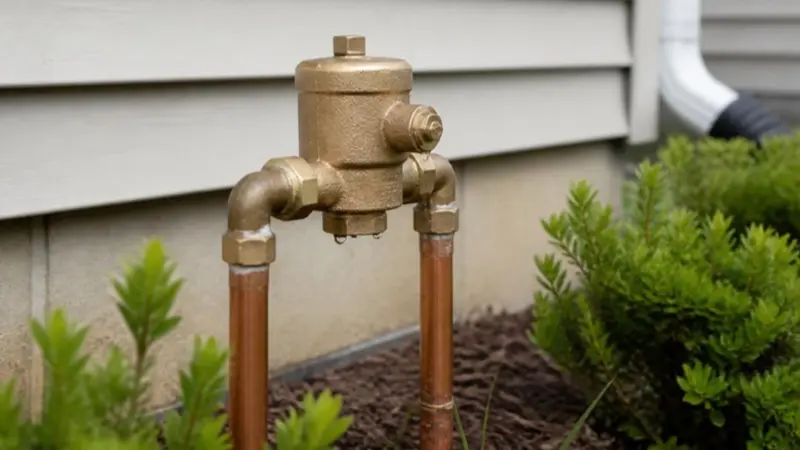
The most common residential device. It must be installed above the highest downstream sprinkler head and is often found beside the foundation.
Double check valve assembly
Two independent check valves in one body. It's permitted in some applications, depending on the hazard and local rules.
Reduced pressure zone (RPZ)
Used for higher-hazard connections, such as systems that inject fertilizer. It has a relief valve that discharges water if a check fails.
What Happens During a Test
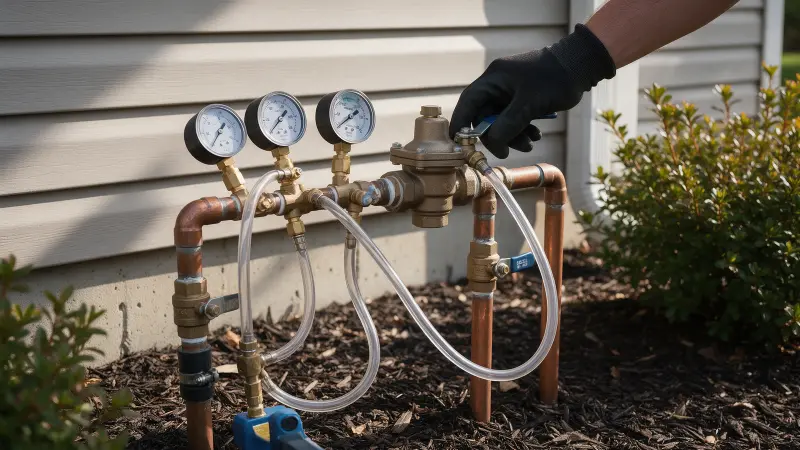
- The tester connects a calibrated test kit to the device's test cocks.
- Each check valve and the air inlet or relief valve is tested against the pressure differentials the device is rated for.
- Results are recorded on a test report with the device's make, model, size and serial number.
- The report is submitted as your water supplier requires, and you should get a copy.
A typical residential test is quick if the device is accessible and in good shape. Buried, obstructed or badly corroded devices take longer.
If Your Device Fails
Common causes of failure are debris fouling a check valve, worn rubber seats and springs, a stuck air inlet poppet, and freeze damage. Many devices can be rebuilt with manufacturer repair kits. A cracked body or bonnet usually means replacement. Either way, the device must pass a retest afterward.
Freeze damage is avoidable. Drain the device and leave its valves half-open before winter, as covered in our Illinois sprinkler winterization guide.
In Romeoville
Your water supplier manages its own cross-connection control program, including how test notices are sent and results are filed. If you live in Romeoville and aren't sure about your device's status, contact the Village of Romeoville Public Works Department. When hiring someone, ask for their IDPH CCCDI license number and a copy of the test report.