What Is a Sprinkler Backflow Preventer?
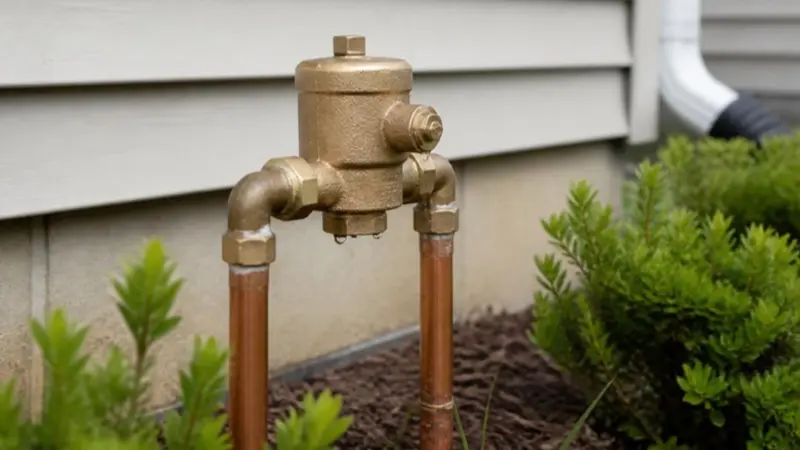
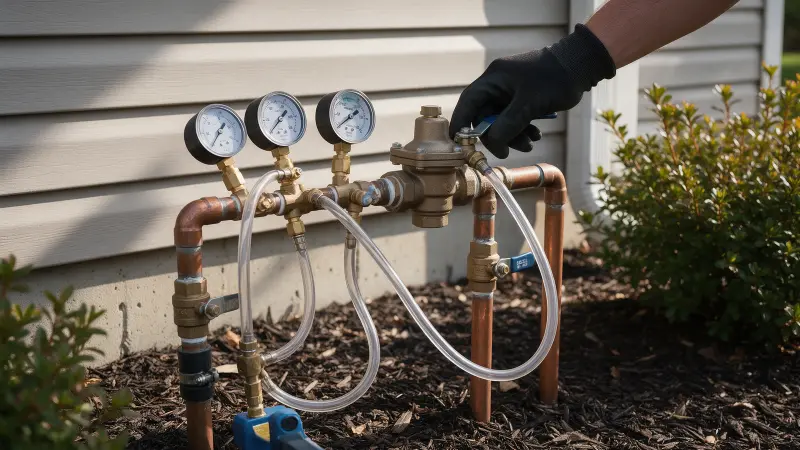
A backflow preventer is the valve assembly, usually a pressure vacuum breaker (PVB) on residential systems, that stops water from your sprinkler lines, which can carry fertilizer, pesticides and soil bacteria, from flowing backward into the home's drinking water. It sits on the always-pressurized supply side, often above ground near the foundation, so when it leaks, it leaks continuously.
Because it's exposed to the weather, the backflow preventer is one of the parts most often damaged by freezing in northern Illinois. Repairing it quickly protects both your water bill and the public water supply, and it's one of the most time-sensitive parts of local irrigation leak repair in Romeoville.
Common Backflow Device Types
Pressure vacuum breaker (PVB)
The most common device on residential sprinkler systems. It must be installed above the highest sprinkler head and has test cocks and shutoff valves for annual testing.
Double check valve assembly
Two independent check valves in one body. It can be installed below grade in some applications where local rules allow.
Reduced pressure zone (RPZ)
Used for higher-hazard connections. A relief valve discharges water if the checks fail, so an RPZ that drips or dumps water is signaling a problem.
Why Backflow Preventers Leak
- Freeze damage. Water left in the body over winter expands and cracks the brass body or bonnet. This is the most common spring failure.
- Worn poppet or seat. On a PVB, a worn air inlet poppet lets water spit from the canopy when the system pressurizes.
- Fouled or worn check valves. Debris or worn rubber prevents the checks from sealing and causes failed tests.
- Test cocks and O-rings. Small leaks at test cocks, unions and shutoff handles are common and usually simple to fix.
- Corrosion and age. Older devices eventually corrode or can no longer be serviced with parts kits.
Device spraying water? Close the irrigation shutoff valve inside the house, which is upstream of the backflow preventer. Nothing downstream will stop it.
Illinois Testing Requirements
Under the Illinois Plumbing Code, lawn sprinkler systems connected to potable water must have backflow protection, and testable backflow devices must be tested annually. Tests are performed by a Cross-Connection Control Device Inspector (CCCDI) licensed by the Illinois Department of Public Health, who records the results and submits them as the water supplier requires. After any repair or replacement, the device should be tested again to confirm it works.
Our guide to backflow testing in Illinois covers what the test involves and what happens if a device fails.
If you've received a test notice or a failed-test report, a provider can review what failed, rebuild or replace the device and retest it. For how Romeoville handles backflow reporting, check with the Village of Romeoville Public Works Department.
Repair or Replace?
Repair makes sense when the body is intact and parts kits are available. Check valves, seats, springs, poppets and O-rings can be rebuilt. Replacement is usually the answer for a freeze-cracked body or bonnet, an obsolete model or heavy corrosion. The new device must be installed at the correct height and orientation for its type, then tested.
Preventing next winter's crack
Before hard freezes, the supply to the system is shut off and the device is drained, with the ball valves and test cocks left half-open so trapped water has room to expand. Then the lines are blown out. An insulated cover adds some protection but doesn't replace draining. The full process is in our Illinois sprinkler winterization guide.
A backflow leak often shows up alongside other freeze damage, so it's worth running every zone at start-up. See sprinkler leak detection and irrigation pipe repair. Backflow repair is available across Romeoville, including Lakewood Falls and Hampton Park. For all services, see irrigation and sprinkler leak repair in Romeoville, IL.