What Does Drip Irrigation Repair Involve?
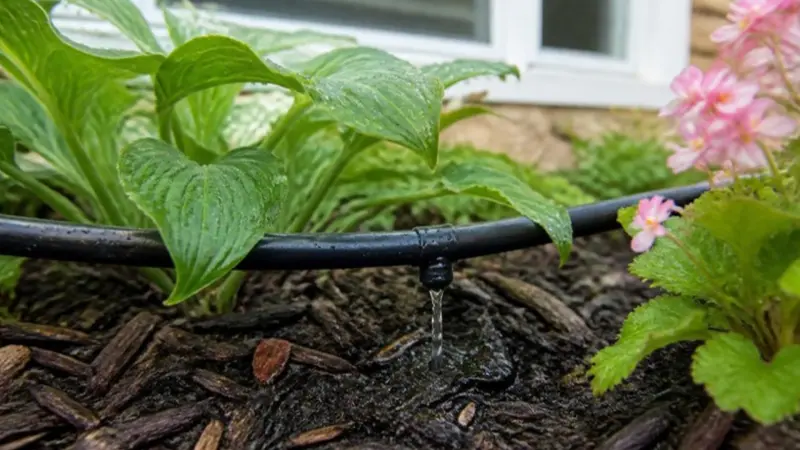
Drip irrigation repair means finding and fixing leaks and blockages in the low-pressure tubing, emitters and fittings that water beds, shrubs and trees at the root zone. That includes splicing punctured drip line, re-securing or replacing blown fittings, replacing missing or clogged emitters, and servicing the zone's filter and pressure regulator.
Drip zones are less visible than lawn sprinklers, so problems often go unnoticed until plants decline or mulch washes out. Drip repair is part of full-system irrigation repair services in Romeoville, and it matters because drip zones typically water the most expensive plantings on the property.
Common Drip System Problems
| Symptom | Likely cause | Typical fix |
|---|---|---|
| Puddle or washout in one spot | Puncture, split tubing or a missing emitter | Splice with a coupling or plug the hole and reinstall the emitter |
| Fittings blowing off | Missing or failed pressure regulator, freeze damage | Replace the regulator and re-seat or replace fittings |
| Plants dry at the end of a run | Clogged emitters, clogged filter, run too long for the flow | Clean the filter, flush the line, replace emitters, split the run |
| Whole zone weak | Clogged filter screen or partly open valve | Service the filter; check the zone valve |
| Tubing exposed or kinked | Mulch loss, animals, digging in beds | Re-route, re-stake and cover the line |
Drip Irrigation Line Repair
Most drip tubing is flexible polyethylene, sometimes with built-in inline emitters spaced along its length. A puncture from a spade, edger or rodent is cut out and joined with a compression or barbed coupling. Point-source systems use individual emitters punched into solid tubing. When one pops out, the hole is plugged with a goof plug or refitted with a new emitter. After any repair, the line is flushed through its end cap so debris doesn't clog the emitters.
Drip Irrigation Emitter Replacement
Emitters are rated in gallons per hour, and plants in the same zone should get emitters sized to their needs: more for a young tree, less for a perennial. Replacing clogged emitters with the same flow rate keeps the zone balanced. Pressure-compensating emitters help keep output even along long runs and slopes.
The Zone Kit: Filter and Pressure Regulator
Drip zones run at far lower pressure than spray heads and have tiny emitter passages, so the start of every drip zone needs a filter and a pressure regulator. A clogged filter starves the whole zone. A failed or missing regulator lets full line pressure hit the tubing, which blows fittings apart. Both are inexpensive to service and are the first things a provider checks. In northern Illinois, drip components also need to be drained before winter along with the rest of the system.
Converting Spray Zones to Drip
Foundation beds and shrub borders watered by spray heads often suffer from overspray onto siding, windows and walks, and from soggy mulch. Converting the zone to drip, either with a retrofit kit on existing risers or by re-piping the bed, puts water where roots are and typically uses less. Spray heads and drip shouldn't share a zone, because they need very different run times. See sprinkler head repair for the lawn side of the system.
Landscaped lots near Mistwood Golf Club and older, well-planted yards in Hampton Park are typical candidates. For every irrigation repair and how the call process works, see our overview of sprinkler leak repair throughout Romeoville.